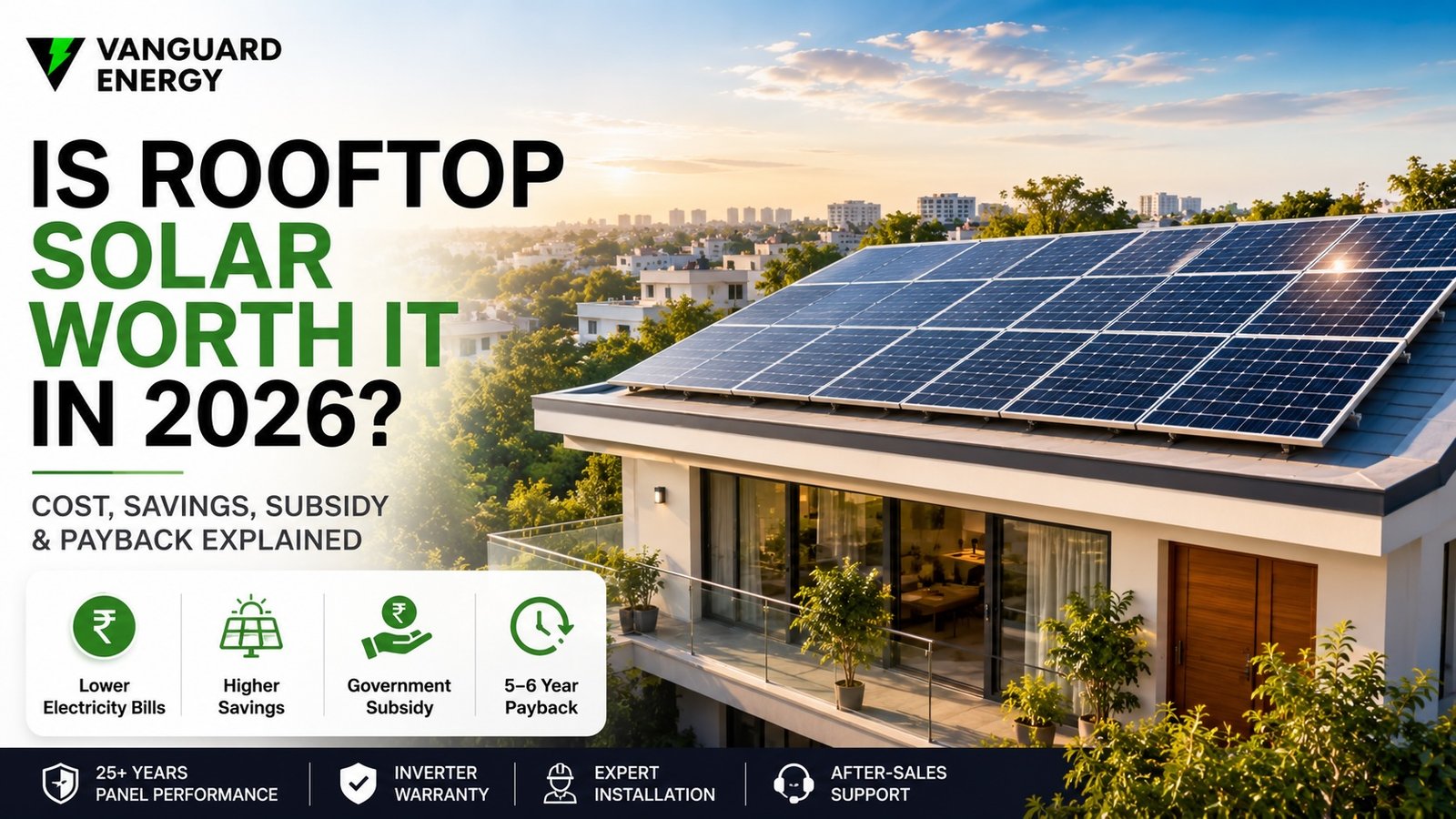
Residential Solar
Aug 24, 2026
Turn Your Rooftop into a Revenue Engine.
Cut your commercial electricity bills by up to 90% with customized 3D-engineered solar installations built for maximum industrial ROI.
 3–4 Years Payback
 22–28% IRR
 25+ MW Installed
 25 Years Support
Solar is an Asset
Vanguard designs and delivers rooftop and small ground-mounted solar systems for offices, institutions, hospitals, warehouses and industrial units.
Plants are sized on electricity bills, built to standards and handed over with clear documentation for long-term savings.
Get Free Quote Rated
4.8
on Google
Rated
4.8
on Google
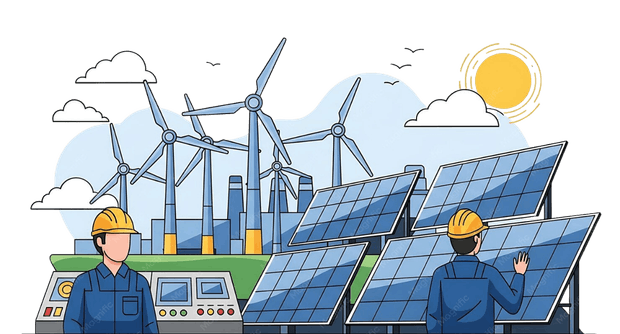
Cuts your electricity bill by up to 70%
Locks in your power cost for 25 years — tariff hikes stop being your problem
Lowers Maximum Demand charges during peak hours
40% accelerated depreciation — a real tax benefit, not just a savings claim
Turns idle rooftop space into a revenue-generating asset
Strengthens your ESG and sustainability compliance
How We Work With You
A clear, no-surprises process — so your management, finance, and facilities teams always know what's next.
Day 1
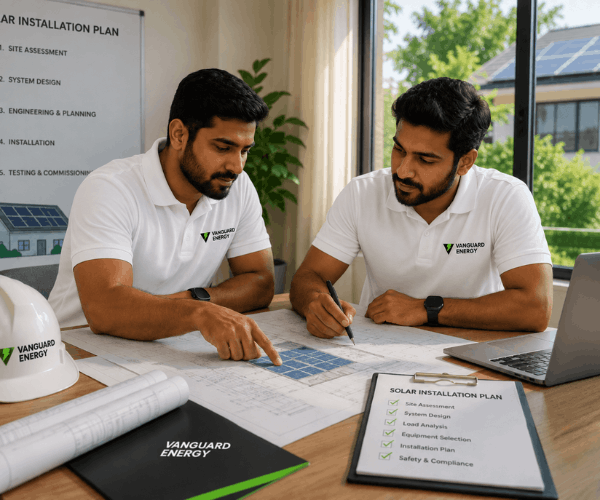
Site Assessment & Data Collection
We study your facility in detail: recent electricity bills, load patterns, backup power setup, working hours, and roof condition — captured through site photographs, drawings, and a physical site visit.
Day 2
Technical & Financial Proposal
You receive a complete picture: recommended system size, layout strategy, 3D solar layout, expected generation, projected savings, payback period, and IRR range — along with phasing options and a maintenance plan built around your operations.
Day 14
Execution & Handover
Installation runs on an agreed timeline with a full safety plan in place. Testing and grid synchronisation are carried out per utility norms — and before we leave, your team gets hands-on training and complete documentation.
Get Your Business
Solar Assessment
Tell us about your facility — our team will map out the right system for you.
Book a Free Site Visit
Our engineers assess your power usage on-site and build a savings plan specific to your business.
3–4 Year Payback. Zero Guesswork. — Straightforward installs, real engineers to talk to — that's the whole approach.

How the Numbers Typically Work
ROI is built on your actual tariffs and consumption profile. The illustration below shows the order of magnitude for well-suited commercial and industrial rooftops.
Tariff and expected escalation are factored into the model.
Each ROI sheet clearly states all underlying assumptions.
Projects can be phased if budgets need to be spread across years.
Day vs night consumption and any DG / backup usage are considered.
| System Size | Annual Units* | Annual Savings @ ₹8 | Indicative Payback | Indicative IRR |
|---|---|---|---|---|
| 100 kW | ~1.48 lakh units | ~11.8 lakh | ~3.5 years | ~27% |
| 250 kW | ~3.70 lakh units | ~29.6 lakh | ~3.3 years | ~28% |
Choose How You Fund Your Solar Plant — We Make Any Path Work
We're connected with leading banks and NBFCs to structure the right financing model for your business — whether you want full ownership, zero balance-sheet impact, or funding without upfront capital.
CAPEX — Own It Outright
Invest upfront and own the plant from day one. Every unit generated goes straight to your bottom line — maximum long-term savings, plus depreciation and tax benefits available only to owners.
Best for:
Businesses with available capital looking for the fastest payback and highest lifetime ROI.
OPEX — Zero Capital, Pay-As-You-Save
Our partner firm funds the plant, Vanguard installs and maintains it on your rooftop. You simply pay for the power you use — at a rate lower than your current grid tariff. No upfront cost, no maintenance burden, savings from month one.
Best for:
Businesses that want savings without capex outlay or asset management responsibility.
LOAN — Own It, Financed
Get up to 90% financing through our banking and NBFC partners to install and own your solar plant, with structured EMIs. You get ownership benefits (depreciation, full savings) without needing the full capital upfront.
Best for:
Businesses that want ownership and tax benefits, but prefer to spread the investment over time.
Talk to Us About the Right Fit for Your Business
* Financing facilitated through Vanguard's banking and NBFC partners; final terms and eligibility subject to lender approval.
Where We've Already Delivered Business Solar
Vanguard has executed rooftop and small ground-mounted projects across education, commercial and industrial segments.
Education & Institutional Campuses
Multi-building schools, colleges and training centres.
- Sites: Schools, colleges, training campuses
- Loads: Classrooms, hostels, labs, common areas
- Profile: Daytime academic schedules with stable base load
Offices, Communities & Public Facilities
Corporate campuses, eco-communities and public buildings.
- Sites: Offices, gated communities, institutions
- Loads: Workspaces, lobbies, lifts, common services
- Profile: Long-term occupancy with strong daytime demand
Industrial & MSME Units
Manufacturing and process-driven enterprises.
- Sites: Industrial sheds, MSME workshops
- Loads: Motors, process loads, auxiliaries
- Profile: Daytime or multi-shift operations
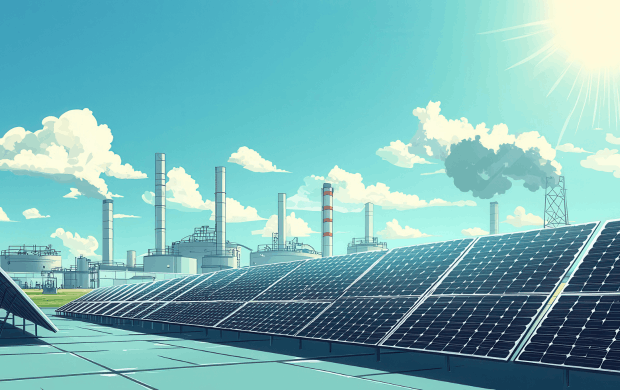
Sustainable Energy
for Every Space
Delivering rooftop and ground-mounted solar systems that fit every sector and energy need.
Trusted by Homes & Businesses
See what our customers have to say.
Ready to Save Lakhs on Your Electricity Bills?
Share your recent electricity bills and basic site details. Vanguard will prepare a concise note with recommended system size, expected annual generation and savings, payback and IRR band, and an indicative layout approach for your building or campus.

Frequently Asked Questions
This starts with a proper energy audit of your facility’s monthly consumption and peak demand pattern — Vanguard sizes your system to your real load profile, not a generic package resized to fit your roof.
Installation is scheduled around your working hours and shift patterns specifically to minimize disruption — this is addressed directly during your free site visit and proposal stage, before any work begins.
Yes — solar can work alongside existing backup infrastructure; your Vanguard consultant assesses your current setup and designs the solar system to complement rather than conflict with it.
Solar generation is limited to daylight hours regardless of your operating pattern, so a facility with significant nighttime load will still rely on the grid (or battery, in a hybrid setup) for those hours — your consultant models your actual load curve against solar generation to set realistic savings expectations.
Typically 3-5 years for on-grid systems, depending on your consumption pattern, local tariff, and financing structure — confirmed with real numbers specific to your facility, not a generic industry average.
Accelerated depreciation allows your business to write off solar asset value against taxable income faster than standard depreciation schedules, improving cash flow in the early years of ownership — the exact benefit depends on your specific tax situation, worth confirming with your finance team alongside Vanguard’s proposal.
CAPEX means your business owns the system outright from day one, keeping all savings and depreciation benefits. OPEX (also called RESCO) means a third party owns and maintains the system while you pay a reduced per-unit rate — typically structured through a Power Purchase Agreement (PPA), a contract defining that rate and term.
Yes — solar components and services attract GST, with panels, inverters, and installation services taxed under different rates. Vanguard’s quotes provide a clear breakdown so you know exactly what’s taxed at what rate, not a single opaque line item.
Vanguard structures payment milestones transparently — typically a portion upfront, a portion on material delivery to site, and the balance on commissioning — confirmed clearly in your proposal before you commit, with no request for unusually large upfront payment.
DCR (domestically manufactured) panels are mandatory if you’re using net metering to export surplus power to the grid. If your facility consumes all generated power on-site with no export, imported panels are typically more cost-effective and often higher-efficiency.
Vanguard only proposes ALMM-listed panels where required for compliance, and can provide the ALMM reference number for your proposed equipment on request.
Yes, potentially — for facilities on HT (high-tension) connections with high sanctioned loads, lower grid draw during peak hours directly reduces MD penalty charges, a benefit distinct from your regular energy bill savings.
In states with Time-of-Day pricing, daytime electricity costs less than evening peak-hour electricity. Businesses that can shift energy-intensive operations into daylight hours let solar cover more of that load precisely when grid power would otherwise be most expensive.
Vanguard’s installations comply with applicable BIS and electrical safety standards, DISCOM interconnection requirements, and — where relevant — factory electrical safety codes specific to industrial facilities.
Vanguard has delivered projects including a solar carport at Begumpet Airport, installations at ICAR and BMW, and multiple railway stations across Vijayawada — a genuinely varied project range. Ask your consultant for references relevant to your specific facility type during your consultation.
Vanguard’s design and installation teams work on your project directly — this matters specifically for commercial and industrial projects, where subcontracting can create real communication gaps and quality inconsistency.
Vanguard backs every commercial and industrial installation with 25 years of structured support — the specific response-time and service terms for your facility are confirmed as part of your proposal, worth discussing explicitly if your operations have particular uptime sensitivity.
Underperformance is addressed through your system’s monitoring data and Vanguard’s ongoing maintenance relationship — real, ongoing accountability rather than a one-time installation handoff, which is exactly why the 25-year support commitment matters for a facility depending on predictable savings.
Commercial Solar Panels and Rooftop Systems for Businesses and Industries
Commercial and industrial solar panels are the visible core of a much larger, carefully engineered system. Combined with mounting structures, inverters, wiring, protection devices, and monitoring equipment, they capture sunlight and convert it into direct current (DC) electricity, which is then converted into usable alternating current (AC) power by a solar inverter — the same power that already runs your machinery, HVAC, lighting, and equipment.
When properly sized to your facility’s actual consumption pattern — not a generic template, and not inflated to hit a sales target — a commercial solar system meaningfully reduces reliance on grid electricity, which is not just expensive but increasingly volatile in cost as fuel prices and demand both rise. For a factory, office, retail space, or institution running significant daytime electricity load, solar isn’t a sustainability add-on anymore — it’s a direct, measurable line-item reduction on your single largest recurring operating expense.
Commercial solar installation cost in India typically ranges between ₹30,000 and ₹50,000 per kW, though the final figure moves meaningfully based on several real variables: panel type (DCR vs. imported panels carry roughly a 15% cost difference), inverter choice (string inverters vs. optimizer-based systems vary by roughly 10-15%), whether battery energy storage is included (which can add up to 30% to total system cost), mounting structure height and complexity, and the depth of after-sales service included in your package.
Why the Installer You Choose Matters More Than the Panels Themselves
It’s tempting to shop commercial solar purely on price-per-kW, but this is a 25-year infrastructure decision, not a one-time purchase. A poorly installed system with premium panels will underperform and fail structurally long before a well-installed system with standard components ever will. What actually determines whether your system delivers its promised savings for the full 25 years comes down to four things: accurate load-based sizing (not oversold capacity), structurally sound mounting engineered for your region’s real wind loads, correct electrical design and DISCOM liaisoning, and — critically — whether the company installing it will still be reachable in year 10, not just year one.
What Does Commercial Solar Installation Actually Cost?
| System Size | Estimated Cost (2026, Indicative) |
|---|---|
| 50 kW | ₹15 - 25 lakh |
| 100 kW | ₹30 - 50 lakh |
| 200 kW | ₹60 lakh - 1 crore |
| 300 kW | ₹90 lakh - 1.5 crore |
| 500 kW | ₹1.5 - 2.5 crore |
| 1 MW | ₹3 - 5 crore |
Final pricing depends on panel type, inverter choice, battery storage inclusion, mounting structure, roof height and condition, and after-sales service level — confirmed precisely during your free site assessment, not estimated from a table.
Vanguard’s Commercial & Industrial Projects
Vanguard has delivered commercial-scale solar across a genuinely varied set of facility types — including a solar carport at Begumpet Airport, installations at ICAR and BMW, and multiple railway stations across Vijayawada. Each of these projects reflects a different load pattern, roof condition, structural constraint, and energy goal — an airport carport, a research institution, an automotive facility, and railway infrastructure are about as different from each other as commercial solar clients get, and that’s exactly why sizing and system design shouldn’t be templated the same way across every site.
Panel Types: DCR vs. Imported — Which Is Right for Your Facility?
| Feature | DCR Panels | Imported (TOPCon) Panels |
|---|---|---|
| Manufacturing | Made in India, per MNRE Domestic Content Requirement norms | Fully manufactured abroad, imported as finished modules |
| Required for | Net-metered systems exporting surplus to the grid | Behind-the-meter systems, no grid export |
| Ideal use case | Consumption pattern uncertain, surplus export likely | Demand predictable, fully self-consumed on-site |
| Relative cost | Higher, due to domestic assembly + net metering requirements | More cost-effective without net metering overhead |
| Handling surplus power | Exported to grid automatically | Consumed on-site; battery storage needed if any surplus exists |
In plain terms: if your facility is likely to generate more than it consumes at any point and needs to export that surplus to the grid, DCR panels aren’t optional — they’re mandatory under net metering regulations. If your consumption is stable and predictable enough that everything generated gets used on-site with nothing left to export, imported panels typically offer meaningfully better economics without any regulatory constraint pushing you toward DCR.
Cell Technology: Mono-PERC vs. TOPCon, in Depth
| Parameter | Mono-PERC | TOPCon |
|---|---|---|
| Silicon type | P-type monocrystalline silicon | N-type silicon |
| Cell design | Rear passivation layer reducing electron recombination | Tunnel oxide + polysilicon layers for enhanced passivation |
| Module efficiency | 20-22% | 25-26% |
| Bifacial gain (if applicable) | ~70% | ~85% |
| Performance in high heat | Stable | Superior — better temperature coefficient |
| Typical degradation | Higher in year 1 (~2%), stabilizing to ~0.6%/year after | Lower throughout — ~1% year 1, ~0.45%/year after |
| Common manufacturers | Domestic DCR-certified brands | Imported brands with strong TOPCon lineups |
TOPCon’s meaningfully higher efficiency, better heat tolerance, and lower long-term degradation rate have made it the increasingly preferred choice for Indian commercial and industrial rooftops specifically — these systems spend enormous amounts of time operating at high rooftop surface temperatures during Indian summers, exactly the condition where TOPCon’s advantage over Mono-PERC is most pronounced.
On-Grid, Off-Grid, and Hybrid — For Commercial and Industrial Use
| Type | Connected to grid? | Needs battery? | How it works | Best for |
|---|---|---|---|---|
| On-Grid | Yes | No | Solar generates, surplus exports, shortfall imports from grid | Predictable loads, reliable grid access |
| Off-Grid | No | Yes | Solar + battery only, fully self-contained, zero grid reliance | No or unreliable grid access at the facility’s location |
| Hybrid | Yes | Yes | Solar first, battery second, grid last — battery specifically covers outages | Facilities where outages genuinely disrupt operations |
How on-grid commercial systems work, step by step: panels convert sunlight into DC electricity through the photovoltaic effect; the inverter converts this to usable, grid-synchronized AC power; any generation surplus to real-time consumption exports automatically to the grid, and any shortfall imports back from the grid during low-generation periods or at night.
How off-grid commercial systems work: identical panel-to-DC conversion, but generated power is used two ways — directly powering real-time load through the inverter, and charging a battery bank with whatever surplus exists, via a charge controller. That stored power then runs your facility whenever solar generation alone isn’t sufficient.
How hybrid commercial systems work: panels generate DC power; the hybrid inverter converts this to AC and prioritizes real-time load first; excess energy charges the battery bank; any further surplus beyond what the battery needs exports to the grid; during outages or after dark, stored battery power takes over automatically, and only once battery capacity is exhausted does the system fall back to grid power.
Most commercial and industrial installations in India remain on-grid, given reasonably reliable grid access across most urban and semi-urban locations — hybrid becomes the meaningfully stronger choice specifically for facilities where outages create real operational or financial disruption (cold storage, continuous manufacturing processes, data-sensitive operations).
The Real Benefits for Your Business — Beyond “It Saves Money”
- Lower, more predictable operating costs: Reducing both your grid electricity bill and your reliance on diesel backup during outages — diesel is not just expensive per unit but increasingly unpredictable in price, which solar generation insulates you from entirely.
- Accelerated depreciation — a genuine, distinct tax benefit: Businesses can claim accelerated depreciation on solar assets, which materially improves cash flow in the early years of the investment — a benefit that exists entirely separate from, and in addition to, the electricity savings themselves.
- Time-of-Day tariff advantages: In states where DISCOMs apply Time-of-Day pricing, electricity is genuinely cheaper during daytime hours and more expensive during evening peak demand. Businesses that can shift energy-intensive operations into daylight hours let solar cover the bulk of that load precisely when grid electricity would otherwise be most expensive.
- Lower Maximum Demand (MD) charges: This is a real, frequently overlooked cost line specifically for facilities with high sanctioned loads on HT (high-tension) connections — factories and large plants in particular. Lower grid draw during peak hours directly reduces MD penalty charges, a cost most competitors’ marketing never mentions because it doesn’t apply to smaller commercial/retail clients the same way.
- Reliable performance under high-temperature conditions: Modern TOPCon panels are specifically engineered to hold their output even as rooftop surface temperatures climb sharply during Indian summer heatwaves — a real operational advantage over older panel technology in this climate.
- Improved thermal comfort for top-floor spaces: Panels function as a protective thermal layer over your roof, reducing direct heat absorption into the building below — lowering rooftop and top-floor temperatures, which in turn reduces HVAC load and improves system efficiency.
- A measurable, reportable reduction in your facility’s carbon footprint: Increasingly relevant for businesses with sustainability commitments, ESG reporting requirements, or corporate clients who audit their supply chain’s environmental practices.
Environmental Impact, by System Size (25-Year Lifetime)
| System Size | Annual CO2 Offset | Equivalent To | 25-Year CO2 Offset |
|---|---|---|---|
| 100 kW | ~1.18 lakh kg | ~5,600 trees | ~29.4 lakh kg |
| 200 kW | ~2.35 lakh kg | ~11,200 trees | ~58.8 lakh kg |
| 300 kW | ~3.53 lakh kg | ~16,800 trees | ~88.2 lakh kg |
| 400 kW | ~4.70 lakh kg | ~22,400 trees | ~1.18 crore kg |
| 500 kW | ~5.88 lakh kg | ~28,000 trees | ~1.47 crore kg |
Financing Options for Commercial & Industrial Solar
Choosing how to fund a commercial solar installation matters as much as choosing the system itself — and Vanguard structures financing around what actually fits your business, not a one-size model.
CAPEX (Capital Expenditure) — Own It Outright: You invest upfront and own the plant from day one. Every unit generated flows directly to your bottom line, and you’re eligible for the accelerated depreciation tax benefit only available to owners. Best suited for businesses with available capital seeking the fastest payback and highest lifetime return.
OPEX (Operating Expenditure) — Zero Capital Outlay: A financing partner funds the plant; Vanguard installs and maintains it on your rooftop. You simply pay for the power you use, at a rate lower than your current grid tariff — no upfront cost, no asset management responsibility, savings from month one. Best suited for businesses that want savings without capital deployment.
Loan-Financed Ownership: Up to 100% financing available through Vanguard’s banking and NBFC partners, with structured EMIs. You get the full ownership benefits — depreciation, complete savings — without needing the full capital upfront. Best suited for businesses that want ownership and tax benefits, but prefer to spread the investment over time.
Maintenance — What Ongoing Ownership Actually Involves
A commercial solar system isn’t “install and forget.” Real, ongoing performance depends on: periodic professional panel cleaning (dust and pollution accumulation genuinely reduces output, more so in industrial areas), scheduled inverter performance checks, wiring and connection point inspections, and — for larger installations — remote performance monitoring to catch any generation shortfall early rather than discovering it months later on a bill. Vanguard’s after-sales service is structured around this reality, not a one-time installation handoff.
Before You Choose an Installer — A Buyer’s Checklist
- Confirm whether your facility’s consumption pattern requires DCR panels (net metering/export) or whether imported panels are viable (fully self-consumed)
- Ask for a real load audit and site-specific sizing, not a generic package sized to a standard building type
- Check the inverter brand and its specific warranty terms, separate from the panel warranty
- Confirm what after-sales maintenance is included, and for how long — this matters enormously for a 25-year asset
- Ask specifically about Maximum Demand charge reduction if your facility runs on an HT connection with high sanctioned load
- Confirm which financing models (CAPEX/OPEX/Loan) the installer genuinely supports, not just advertises
- Request references or case studies from facilities similar in scale and load pattern to your own
Common Myths About Commercial Solar
Myth: Commercial solar is only worth it for very large factories.
Fact: Any facility with meaningful daytime electricity consumption — offices, retail spaces, educational institutions, warehouses — can see real payback from correctly sized solar, not just heavy industry.
Myth: There’s no financial incentive for commercial solar since there’s no subsidy.
Fact: While the PM Surya Ghar subsidy doesn’t apply to commercial systems, accelerated depreciation is a genuine, separate tax benefit — plus MD charge reduction and Time-of-Day tariff advantages that residential customers don’t have access to at all.
Myth: Bigger systems always mean proportionally bigger savings.
Fact: Oversizing beyond your actual consumption and export capacity wastes capital — a system genuinely matched to your load and roof capacity delivers better realized ROI than the largest system your roof can physically hold.
Solar Terms for Business Buyers, Explained
DCR (Domestic Content Requirement) — Panels manufactured in India per MNRE norms, mandatory for net-metered commercial systems.
Behind-the-Meter — A system where all generated power is consumed on-site, with no grid export involved.
Accelerated Depreciation — A tax provision allowing businesses to write off solar asset value against taxable income faster than standard depreciation schedules, improving early-year cash flow.
Maximum Demand (MD) Charges — Additional charges DISCOMs apply to HT connections that draw power above their sanctioned load during peak periods — directly reduced by lower grid draw from solar generation.
Time-of-Day (ToD) Tariff — A pricing structure where electricity costs more during peak evening hours and less during the day, making daytime solar generation especially valuable for businesses that can shift operations accordingly.
PPA (Power Purchase Agreement) — A contract structure (part of the OPEX model) where a business agrees to purchase power generated by a solar system at an agreed rate, without owning the system itself.
Why Vanguard for Commercial & Industrial Solar
Choosing a solar EPC for your business isn’t really a purchasing decision — it’s choosing who’s accountable for a 25-year piece of your facility’s infrastructure. Here’s what that accountability actually looks like with Vanguard.
We Size to Your Bill, Not Our Sales Target
Most solar quotes are built to hit a number the sales team needs, not the number your facility actually requires. Every Vanguard proposal starts with your real electricity bill and consumption pattern — not a generic package resized to fit your roof. That means you’re not paying for capacity you’ll never use, and you’re not left with a system too small to move the needle on your bill either. This is the single biggest reason to be skeptical of any quote that arrives before a real site visit has happened.
Government-Recognized, Not Self-Certified
Vanguard is empanelled with the Ministry of New and Renewable Energy (MNRE) and registered under the PM Surya Ghar Muft Bijli Yojana. This isn’t a badge we assign ourselves — empanelment means every installation meets defined technical standards verified by a government body, and every subsidy or approval process we handle on your behalf goes through official, recognized channels. When you’re trusting a vendor with a 25-year infrastructure investment, this is the difference between a real credential and a marketing claim.
Real Projects, Real Range
Vanguard has delivered commercial-scale solar across genuinely different facility types — a carport at Begumpet Airport, installations at ICAR and BMW, and multiple railway stations across Vijayawada. This range matters: an airport carport, a research institution, an automotive facility, and railway infrastructure each come with different structural constraints, load patterns, and regulatory requirements. A team that’s handled that range has already solved problems your facility’s specific situation is likely to raise — not learning on your project for the first time.
25 Years of Support, Not a One-Year Contract That Expires Quietly
A solar plant is a 25-year asset. Most installers’ actual involvement ends the day the invoice is settled. Vanguard’s after-sales commitment runs for the full 25 years — scheduled maintenance, performance monitoring, and a team that’s still reachable in year 12 the same way they were in month one. If your system underperforms, you’re not starting from scratch trying to find someone who remembers your installation.
Structures Engineered for Real Weather, Not Just the Sales Photo
Every Vanguard mounting structure is engineered to withstand high wind speeds, using corrosion-resistant materials built to hold up through monsoons and cyclones across the full working life of your system — not just look good in the installation photos before the first serious storm tests it.
We Manage the Whole Process, Not Just the Installation
DISCOM coordination, net metering approvals, and — for eligible components — subsidy paperwork are handled by Vanguard’s team from start to finish. Your facilities team gets a completed, commissioned system, not a stack of government forms to chase down between other responsibilities.
Financing Structured Around Your Business, Not a Single Model
CAPEX, OPEX, and financing up to 100% through our banking and NBFC partners — Vanguard doesn’t push every client toward the same financing structure regardless of their actual capital position. Whether you want full ownership and the depreciation benefit, or zero-upfront savings through an OPEX arrangement, the right model depends on your business, not our preference.
A Team You Can Actually Reach
Solar installers that operate through layers of subcontractors and resellers create real accountability gaps — when something goes wrong, it’s unclear who’s actually responsible for fixing it. Vanguard’s team handles design, installation, and after-sales support directly, so there’s one accountable point of contact throughout your system’s 25-year life, not a chain of intermediaries to navigate when you need help.
Frequently Asked Questions
What is a commercial solar panel?
The core component of a commercial solar system — it captures and converts sunlight into DC electricity, which an inverter then converts into usable AC power for your facility.
Which panel type is best for commercial use?
Imported panels (typically TOPCon) are generally more cost-effective and efficient for facilities consuming all generated power on-site. DCR panels are specifically required when net metering and grid export are part of your setup.
What does commercial solar cost in India?
Roughly ₹30,000-50,000 per kW, varying by panel type, inverter choice, battery inclusion, and site conditions — confirmed precisely during your free site assessment.
How many panels does a commercial system actually need?
Number of panels = system size (in watts) ÷ panel wattage. For example, a 1 MW system using 580W panels needs approximately 1,725 panels; using 545W panels, approximately 1,835.
What’s the lifespan of a commercial solar system?
With proper, periodic maintenance, 25 years — continuing to generate at roughly 80% of original output even at that point, given standard industry degradation rates.
Is there a government subsidy for commercial solar?
No — the PM Surya Ghar subsidy applies to residential systems only. Commercial and industrial systems remain a strong investment regardless, given accelerated depreciation benefits, MD charge reduction, and 25 years of largely free electricity once the system pays back its own cost.
How does Maximum Demand charge reduction actually work?
DISCOMs bill HT connections partly based on peak power drawn from the grid during a billing period. Since solar generation reduces how much power you draw from the grid during daylight peak hours, it directly reduces this charge — a benefit distinct from, and in addition to, your regular energy bill savings.
Can our facility use both CAPEX and OPEX models for different parts of the installation?
This is a conversation worth having directly with Vanguard’s team — financing structures can sometimes be tailored to a facility’s specific capital situation, and it’s better discussed during your site assessment than assumed from a generic answer here.
Does installation disrupt our daily operations?
Vanguard schedules installation around your working hours and shift patterns specifically to minimize disruption — this is addressed directly during your free site visit and proposal stage.
What happens if our energy consumption grows after installation?
A properly sized system accounts for reasonable growth, but if your consumption significantly increases, Vanguard can assess whether system expansion is feasible given your available roof area and sanctioned load — worth a direct conversation as your business scales.