Your Roof. Your Power Plant.
Zero Investment, 90% Lower Bills!
 Rated
4.8
on Google
Rated
4.8
on Google
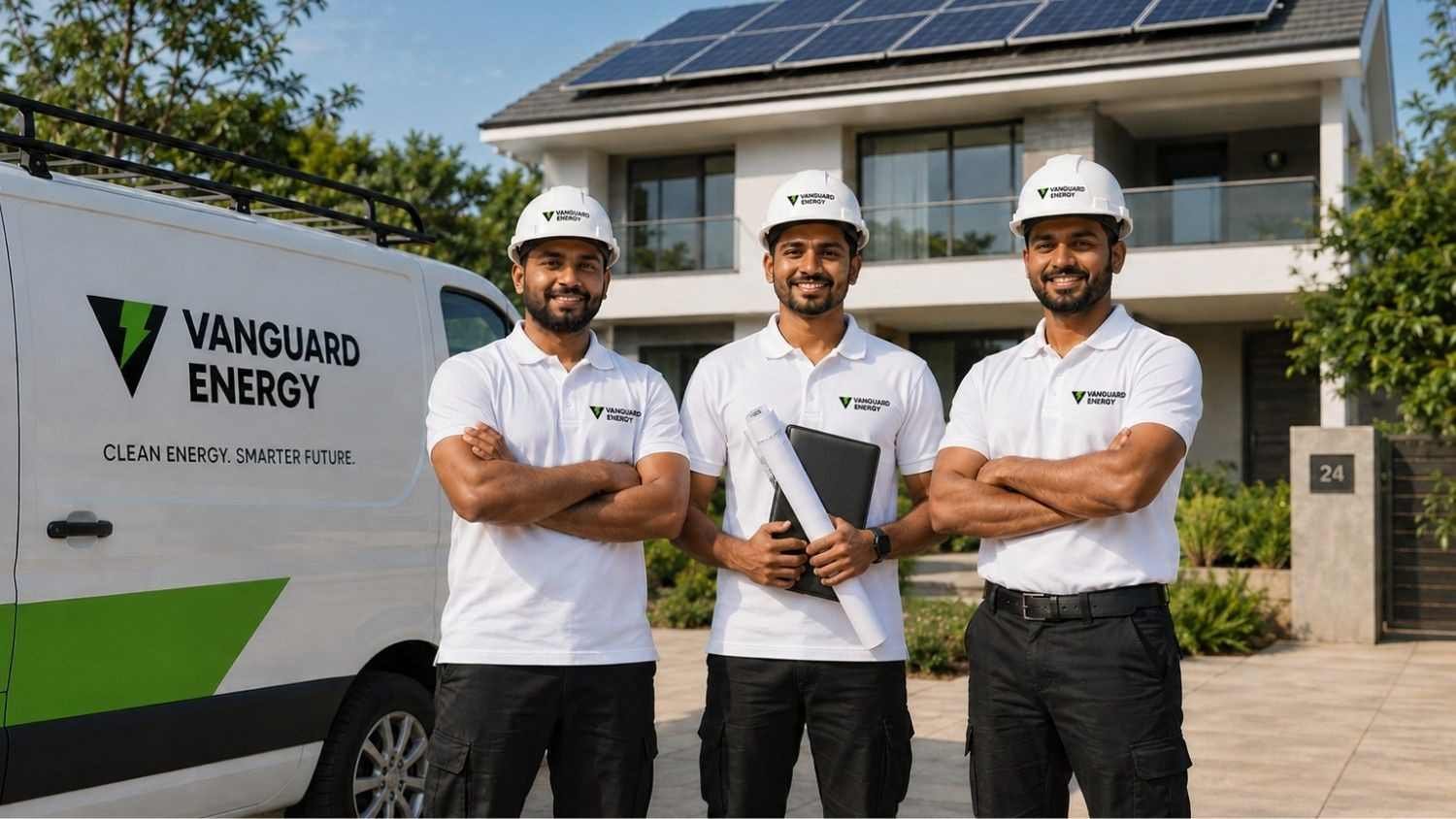
Book a FREE Consultation
Get genuine advice from our solar experts.
No pressure, book only if you are satisfied!

Why India Chooses Vanguard

Bill-Based Sizing
Every system sized to your actual bill, not a sales target.

Seamless Experience
Survey to subsidy, our experts handle everything. Zero middlemen.
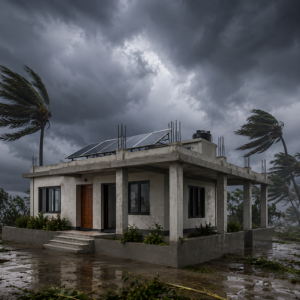
Cyclone-Proof Structures
Engineered for 170 kmph winds. Built for lasting durability.

Subsidy, Fully Handled
Government subsidy of up to ₹78,000, applied and tracked by our team.
Our Products
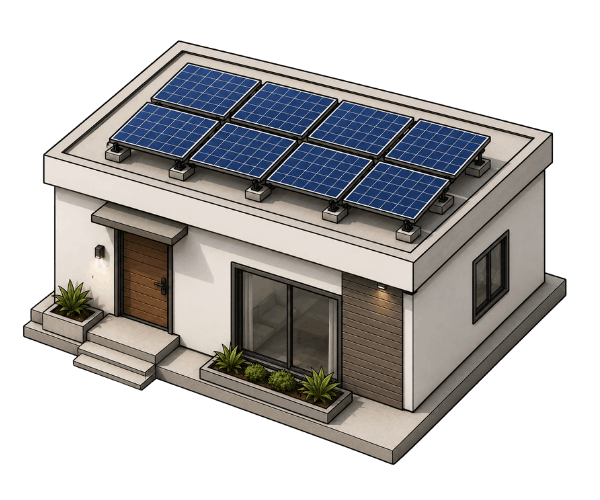
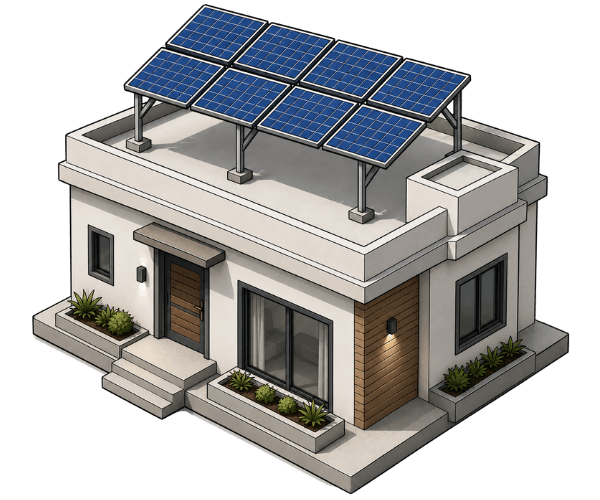
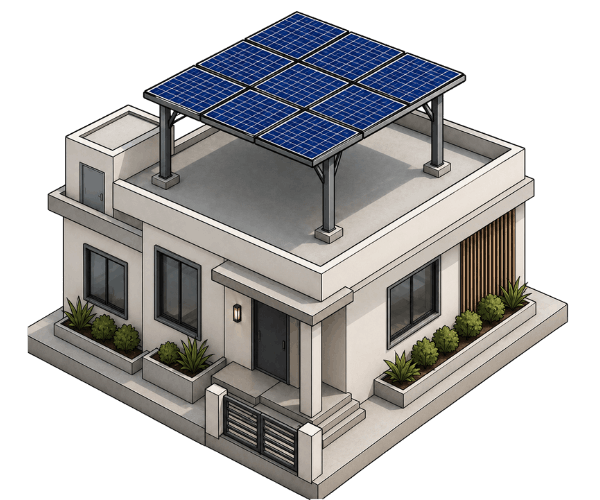
Zero Investment.
All Upside.
The government subsidy handles your down payment — your monthly savings cover the rest.

Get Savings and EMI Estimates
Your Monthly Saving
₹5,900
for 25 years!
Monthly EMI
₹3,500
60 months
4 Steps. 0 Headaches.
90% Lower Bills.
Day 1: We Survey Your Roof
Our engineers map your rooftop, shading, and power usage on site.
Day 2: You Approve the 3D Design
See exactly how your system will look before we install a single panel.
We Install, We File the Subsidy
Our crew handles setup and the full government paperwork — zero forms land on your desk.
Day 21+: You Save, We Watch
Savings start immediately; our team monitors performance for 25 years.

Powering Homes Across India

2500+
Happy Customers

Up to 100%
Financing

25 Years
Support

25+ MW
Installed

Calculate your savings
Select your state and average monthly electricity bill to calculate your savings.
Trusted by Homes & Businesses
See what our customers have to say.
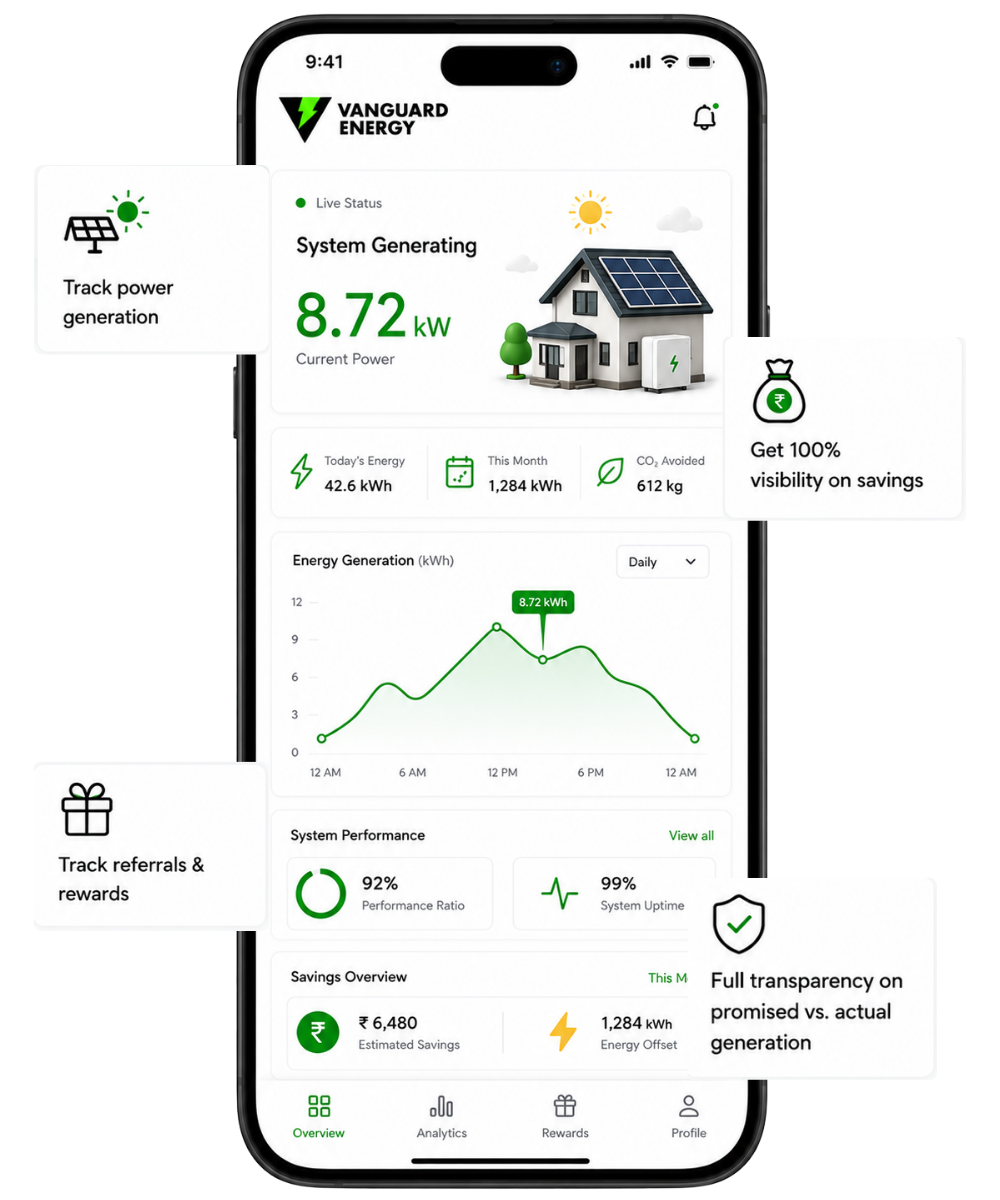
Real-time Monitoring App
Your System, Live — 24/7 From Your Phone. Watch your kW output update in real time, from anywhere.





Frequently Asked Questions
Rooftop Solar for Your Home: What It Actually Costs, and What It Actually Saves
Installing solar on your home isn’t really a 25-year decision — it’s a decision that pays you back within the first 3-5 years, and then keeps paying you for the next 20. Once your system’s cost is recovered, the electricity it generates for the rest of its working life is functionally free. Over that full 25-year span, the total savings for a well-sized system typically run into several multiples of what you spent — the exact number depends on your city, your consumption pattern, and your local tariff, which is exactly what Vanguard’s Solar Savings Calculator is built to estimate for your specific bill.
What Determines the Cost of Home Solar in India
Solar system pricing isn’t one flat number — it depends on your system size, your city (DISCOM charges and local installation costs vary by region), the panel and inverter brand you choose, your roof type and height, and the level of after-sales support included. Vanguard’s team walks you through this transparently during your free site visit — a real, itemized estimate based on your actual roof and bill, not a generic online quote.
What Does Home Solar Actually Cost?
| System Size | Estimated Cost (2026, Indicative) |
|---|---|
| 2 kW | ₹1.8 - 2.1 lakh |
| 3 kW | ₹2.1 - 2.5 lakh |
| 5 kW | ₹2.9 - 3.5 lakh |
| 10 kW | ₹5.5 - 6.5 lakh |
Final pricing depends on your city, DISCOM charges, panel and inverter type, mounting structure height, and after-sales service level — confirmed precisely during your free site assessment.
Government Subsidy — The Real Numbers
The PM Surya Ghar Muft Bijli Yojana offers homeowners nationwide a central subsidy of up to ₹78,000, structured as follows:
| System Size | Central Subsidy |
|---|---|
| 1 kWp | ₹30,000 |
| 2 kWp | ₹60,000 |
| 3 kWp and above | ₹78,000 (capped) |
This subsidy is uniform across every state in India — no matter where you live, the central government contribution stays the same. A small number of states layer additional state-level incentives on top; Vanguard’s consultant will confirm during your site visit whether any extra state subsidy currently applies to your specific location.
Who’s Eligible for the Subsidy?
You qualify for the PM Surya Ghar subsidy if:
- You’re an Indian citizen installing a grid-connected system using ALMM-approved (domestically manufactured) panels
- You legally own the property or roof where the system will be installed
- You hold an active DISCOM electricity connection in your own name
- You haven’t previously received a solar subsidy for a system up to 3kW
How the Subsidy Application Actually Works
The subsidy is claimed through the national PM Surya Ghar portal, and Vanguard manages this process on your behalf from start to finish — but here’s what it actually involves, so you know what’s happening at each stage:
- Registering your consumer details and DISCOM connection
- Submitting your application with supporting documents and bank information
- Selecting your DISCOM-approved installer (Vanguard)
- Uploading the signed installation agreement
- Completing net meter installation once your system is live
- Formally requesting subsidy release after your DISCOM inspects and issues a commissioning certificate
The subsidy is typically credited directly to your bank account once approved. You won’t need to navigate any of these steps alone; our team handles the DISCOM coordination and paperwork throughout.
How Long Does Installation Actually Take?
Timelines depend on several factors outside any installer’s direct control — most significantly, how quickly your DISCOM processes the net metering application and final commissioning, since that step depends entirely on the utility’s own workload and approval process. What Vanguard controls directly — the site visit, system design, and physical installation — moves quickly once you’ve approved your proposal. Your Vanguard consultant will give you a realistic, honest timeline specific to your location and DISCOM during your free consultation, rather than a generic promise that doesn’t account for real-world variability.
How Vanguard Installs Your Home System
- Rooftop Assessment — Our engineer evaluates shadow-free space, roof strength, and ideal panel orientation and tilt
- Mounting Structure Installation — Wind-rated, corrosion-resistant structures secured to your roof
- Panel Placement — Panels fastened according to manufacturer torque specifications
- Inverter & Wiring Setup — DC power routed through safety devices and converted to AC
- Net Meter Installation — Your DISCOM replaces your existing meter with a bi-directional net meter
- Earthing & Lightning Protection — Dedicated grounding for electrical and surge safety
- System Commissioning — Final checks completed and your system activated for generation
Maintenance — What Ongoing Ownership Actually Involves
Routine maintenance for a home system is light: periodic professional panel cleaning (every 3-6 months, more often in dusty environments), an annual inverter performance check, and visual inspection of mounting hardware and wiring. Vanguard’s after-sales service covers this on a scheduled basis for the full 25 years we back every residential installation — not a short introductory period that quietly expires.
The Real Benefits of Going Solar at Home
- A meaningfully lower electricity bill, often reduced substantially once your system covers the bulk of your daytime consumption
- A real environmental impact — every kilowatt installed avoids a measurable amount of CO2 emissions annually, compounding across your system’s 25-year working life
- Energy independence from a grid whose tariffs only trend upward over time — a 3-6% annual tariff increase is a realistic planning assumption, which means the value of your own generation grows every year
- A long-term financial asset, not a depreciating purchase — once the system pays back its own cost, everything after that is pure savings for two more decades
On-Grid vs. Off-Grid for Homes — Which Is Right for You?
| Feature | On-Grid | Off-Grid |
|---|---|---|
| Connected to the grid? | Yes | No |
| Needs a battery bank? | No | Yes |
| Subsidy eligible? | Yes | No |
| Works during a power cut? | No | Yes |
| Relative cost | Lower | Higher |
| Best for | Homes with reliable, consistent grid access | Homes with no or unreliable grid access |
For the majority of Indian homes with reasonably stable grid electricity, on-grid is the simpler, faster-paying-back choice. If frequent outages are a real concern, a hybrid system — which adds battery backup on top of the same grid-tied foundation — is worth exploring instead of going fully off-grid.
Before You Choose an Installer — A Buyer’s Checklist
- Confirm the panels are ALMM-listed, required for subsidy eligibility
- Ask for a structural assessment of your roof’s load-bearing capacity, not just a verbal estimate
- Check the inverter brand and its warranty terms specifically, not just the panel warranty
- Ask exactly what after-sales service is included, and for how long
- Confirm the installer handles your DISCOM approval and net metering application, not just the physical install
- Request a site-specific generation estimate based on your actual roof, not a generic template figure
Common Myths About Home Solar
Myth: Solar panels don’t generate any power on cloudy days.
Fact: They still generate electricity on cloudy days — output is reduced, but not zero.
Myth: An on-grid system will keep your lights on during a power cut.
Fact: It won’t — anti-islanding protection shuts the system down for safety during any grid outage. A hybrid system is needed for backup power.
Myth: Panels need to be cleaned every single day to work properly.
Fact: Quarterly to biannual professional cleaning is typically sufficient for most locations — daily cleaning is unnecessary and can even risk panel damage if done incorrectly.
Myth: You need to pay the entire system cost upfront.
Fact: With financing up to 100% through Vanguard’s banking and NBFC partners, plus the government subsidy reducing the effective cost further, upfront capital doesn’t have to be the barrier.
Solar Terms, Explained Simply
kWp vs kW — kWp (kilowatt-peak) is a panel’s rated capacity under standard test conditions; kW is the actual power being generated or consumed at a given moment.
DISCOM — The Distribution Company, your local electricity utility responsible for supplying power and approving your net metering connection.
ALMM — Approved List of Models and Manufacturers, the government’s certified list of domestically manufactured panels eligible for subsidy.
Net Metering — The billing arrangement where your bi-directional meter tracks and nets out electricity you export to and import from the grid.
Anti-Islanding Protection — A mandatory safety feature that shuts an on-grid inverter down during a grid outage, protecting utility workers repairing the fault.
Why Vanguard for Your Home Solar Installation
Choosing who installs solar on your home isn’t really a purchasing decision — it’s choosing who’s accountable for a 25-year piece of your house. Here’s what that accountability actually looks like with Vanguard.
We Size to Your Bill, Not Our Sales Target
Most solar quotes are built to hit a number the sales team needs, not the number your home actually requires. Every Vanguard proposal starts with your real electricity bill and consumption pattern — not a generic package resized to fit your roof. That means you’re not paying for capacity you’ll never use, and you’re not left with a system too small to move the needle on your bill either.
Government-Recognized, Not Self-Certified
Vanguard is empanelled with the Ministry of New and Renewable Energy (MNRE) and registered under the PM Surya Ghar Muft Bijli Yojana. This isn’t a badge we assign ourselves — empanelment means every installation meets defined technical standards verified by a government body, and every subsidy application we submit goes through official, recognized channels.
Structures Built for Real Indian Weather
Our mounting structures are engineered to withstand high wind speeds, using corrosion-resistant materials designed to hold up through monsoons and storms for the full working life of your system — not just the installation photos.
A Team That Stays After the Sale
We don’t disappear after your panels go up. Vanguard backs every residential installation with 25 years of support — scheduled maintenance visits, performance monitoring, and a team you can actually reach, not a contract that quietly expires just as problems start showing up.
Financing That Removes the Upfront Barrier
Through our banking and NBFC partners, Vanguard offers financing of up to 100% — so the initial cost doesn’t have to be the reason you delay going solar.
Real-Time Visibility Into Your Own System
Our monitoring app gives you direct access to your system’s generation data, so you can see exactly what it’s producing — not just trust a promised number.
Frequently Asked Questions
Why should I switch to solar?
If you’re dealing with high electricity bills, solar is the most direct way to bring them down — while also reducing your dependence on the grid and your household’s carbon footprint.
How high does my electricity bill need to be for solar to make sense?
Vanguard offers solutions for homes of various sizes, but the investment tends to work out best economically once your monthly bill reaches a meaningful threshold — your Vanguard consultant can confirm whether solar makes sense for your specific bill during a free consultation.
How much can I actually save with solar?
Most homeowners see a substantial reduction in their electricity bill from day one, and since grid tariffs rise over time, the value of your own generation only increases in the years after installation.
I’m not sure if I have enough roof space.
That’s exactly what your free site visit is for — a Vanguard consultant evaluates your actual space and power needs and gives you a real, personalized system recommendation. You only proceed if you’re happy with what’s proposed.
Do I need to pay a large amount upfront?
No — with financing options and the government subsidy reducing your effective cost, you can go solar without a large initial outlay.
How complicated is the subsidy process?
We understand the paperwork can feel daunting — Vanguard manages the entire application and DISCOM coordination on your behalf.
What is the lifespan of a home solar system?
25 years or more with proper maintenance — panels keep generating clean power for decades, and Vanguard’s after-sales service keeps your system in shape throughout that life.
Do panels alone guarantee long-term savings?
Not entirely — panel quality is only one part of the equation. System design, a strong mounting structure, and regular maintenance all affect your long-term generation and savings. A weak link in any of these will cause output to drop over time, which is why Vanguard treats installation quality and after-sales support as equally important as panel choice.
How will I know how much power my system is generating?
Through Vanguard’s monitoring app, connected directly to your system, giving you real-time visibility into generation and savings.
Do solar panels work at night?
No — panels require sunlight to generate electricity. At night, an on-grid system draws power from the grid as usual.